
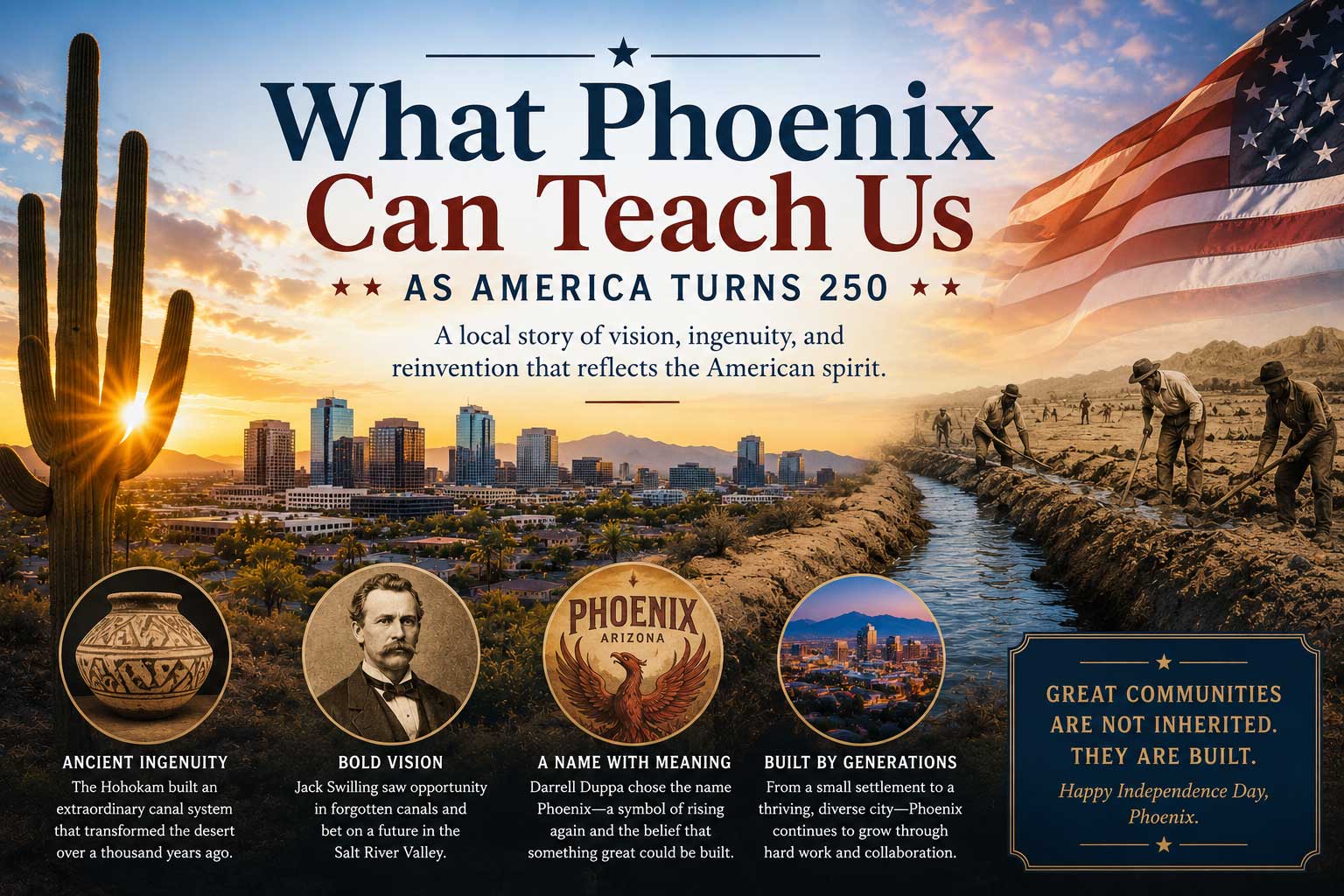
As America approaches its 250th birthday, many of us will spend the Fourth of July doing what generations before us have done: gathering with family, firing up the grill, finding a good place to watch fireworks, and taking a moment to appreciate the freedoms we often take for granted.
Anniversaries invite reflection. They encourage us to look back at where we’ve been, how far we’ve come, and what kind of future we’re building together.
When we think about America’s founding, we often think of famous names, historic documents, and events that unfolded nearly 250 years ago. Yet the American story has never belonged to a single place or a single generation. It has continued to unfold in communities across the country, shaped by people willing to build, adapt, solve problems, and invest in a future they might never fully see themselves.
That is one reason Phoenix is such an interesting place to consider this Independence Day.
Phoenix is not 250 years old. The city would not begin taking shape until nearly a century after the Declaration of Independence was signed. Yet the qualities that helped build Phoenix—vision, ingenuity, perseverance, and a belief in possibility—are many of the same qualities that have shaped America throughout its history.
The story of Phoenix is ultimately a story about people who looked across a difficult landscape and imagined something more. In that sense, it may be one of the most American stories of all.
The First Builders of the Valley
Long before Phoenix appeared on a map, the Salt River Valley was home to the Hohokam people, one of the most remarkable civilizations in North American history.
Beginning more than a thousand years ago, the Hohokam developed an irrigation network unlike anything else north of Mexico. Archaeologists estimate they built hundreds of miles of canals throughout the Valley, some stretching more than twenty miles in length and capable of carrying water across vast sections of desert. Their achievement was extraordinary. Using simple tools and a deep understanding of the landscape, they diverted water from the Salt River and transformed the desert into productive farmland.
The Hohokam were not simply farmers. They were engineers, builders, traders, and planners whose communities maintained connections throughout the Southwest and into present-day Mexico. Corn, beans, squash, cotton, and other crops flourished where many outsiders would have assumed agriculture was impossible. Their canal system was so effective that portions of modern irrigation infrastructure still follow routes first established by Hohokam builders centuries ago.
For centuries, life flourished in the Valley. Then, sometime between approximately 1300 and 1450, many of the Hohokam communities disappeared. Historians continue to debate exactly why. Extended drought, flooding, resource pressures, and social changes have all been suggested as possible causes. Whatever the reason, the people largely vanished from the region, leaving behind one of the greatest engineering achievements in North American history.
The canals remained.
When later settlers arrived centuries afterward, they found traces of those waterways cutting across the desert floor. Most people saw abandoned earthworks. One man saw a blueprint for the future.
The Decision That Changed Everything
In 1867, a frontiersman named John “Jack” Swilling arrived in the Salt River Valley. Swilling had already lived a remarkable life. He had worked as a miner, rancher, freighter, scout, and entrepreneur. More importantly, he possessed a rare ability to recognize opportunity where others saw only hardship.
When Swilling encountered the remnants of the Hohokam canal system, he immediately understood what many people overlooked. Those canals represented water. Water meant agriculture. Agriculture meant settlement. Settlement meant a future.
Swilling organized what became known as the Swilling Irrigation and Canal Company and convinced others to help reopen portions of the ancient canal network. It was a risky undertaking. Arizona was still a rugged frontier. Summers were unforgiving. Infrastructure was limited. Many questioned whether large-scale farming could ever succeed in the desert.
Yet the gamble worked.
Within a short time, wheat, barley, and corn were growing where there had previously been only dry desert. Word spread quickly. Farmers arrived. Merchants followed. Families came seeking opportunity. A community began to emerge around the restored canals, proving that the Valley could support growth if people were willing to invest in its future.
The success of those early efforts established a pattern that would define Phoenix for generations. Again and again, the city would grow because people were willing to take risks, solve problems, and build something larger than themselves.
The English Adventurer Who Named Phoenix
Every great city seems to have a few colorful characters in its origin story. Phoenix is no exception.
One of the most fascinating figures in early Arizona history was Phillip Darrell Duppa. Born in Paris to English parents, Duppa was educated, well-traveled, and endlessly adventurous. He eventually made his way to the Arizona Territory, where his personality stood out even among the larger-than-life pioneers of the American West.
Duppa often went by the title “Lord” Darrell Duppa, despite never actually holding a noble title. Some accounts describe him as a gambler. Others describe him as a writer, explorer, and gentleman adventurer. Whatever the label, he possessed something unusual for the frontier: a deep appreciation for history, literature, and classical mythology.
His influence can still be found throughout the Valley today. Duppa is widely credited with naming Tempe after the famed Vale of Tempe in Greece. But his most enduring contribution would be helping give Phoenix its name.
As the settlement around Swilling’s canals continued to grow, residents began discussing what to call the new community. Several names were considered. Swilling reportedly preferred “Stonewall,” after Confederate General Stonewall Jackson. Others suggested names connected to the Salt River. Some residents referred to the area simply as “Swilling’s Mill” or “Mill City.”
Need a reliable dumpster partner in Phoenix? 📞 Call Now! or start here.
None of those names captured the larger story unfolding in the Valley.
Duppa saw something that others had missed.
The settlement was not being built on untouched land. It was rising from the remnants of an earlier civilization. The restored canals followed pathways first engineered by the Hohokam centuries before. Fields that had once supported thriving communities were producing crops again. Life was returning to a place that had been largely abandoned.
To Duppa, the image was obvious.
He proposed the name Phoenix.
The mythical phoenix is a bird that rises from its own ashes after death. To Duppa, the growing settlement resembled a new civilization emerging from the remains of an older one. The comparison was poetic, but it was also historically accurate. Without the ancient canal system left behind by the Hohokam, modern Phoenix likely would never have developed where it did.
The name captured the imagination of the settlers, and it stuck.
More than 150 years later, it remains one of the most fitting city names in America.
A City Built on Reinvention
The symbolism behind the name Phoenix has proven remarkably durable.
What began as a settlement supported by irrigation canals became an agricultural center. What began as a frontier outpost became the capital of a territory and eventually a state. What was once considered an unlikely place for a major city became one of the largest metropolitan areas in the United States.
Railroads arrived. Industry expanded. Air conditioning transformed growth patterns. Universities, hospitals, manufacturers, technology companies, logistics providers, and countless other industries reshaped the local economy. New residents continue to arrive from around the country and around the world, each bringing their own contributions to the city’s story.
Despite all that change, Phoenix’s origin story remains surprisingly relevant. The city continues to thrive because people continue to see possibility where others see limitations. That mindset has been part of the Valley’s DNA from the beginning.
Perhaps that is why Duppa’s choice of name still feels so appropriate. Phoenix has spent more than a century proving that reinvention is not a one-time event. It is part of the city’s identity.
Looking Ahead to America’s 250th Birthday
The Fourth of July is often focused on celebration, and rightly so. But it can also be an opportunity to appreciate the people who built the communities we call home.
As America marks 250 years, we naturally look back to the founders, the documents, and the events that shaped the nation. Yet the American story has always been larger than any single moment in history. It has been carried forward by generations of people willing to see opportunity where others saw obstacles.
The Hohokam engineers who first transformed the Salt River Valley. Jack Swilling reopening forgotten canals. Darrell Duppa imagining a city worthy of a memorable name. The generations of builders, entrepreneurs, teachers, tradespeople, and families who followed.
Their stories are different, but they share something in common: the belief that something better could be built here.
The people who restored those ancient canals in the late 1860s could never have imagined the skyline, neighborhoods, businesses, and communities that define Phoenix today. Yet their decisions helped make all of it possible.
As America turns 250, that may be one of the most meaningful lessons Phoenix has to offer.
Great communities are not inherited. They are built.
And in that way, Phoenix may be one of the most American stories of all.
Happy Independence Day, Phoenix. Here’s to the builders who came before us—and to the generations still writing the city’s story.
Sources & Further Reading
Interested in learning more about the history of Phoenix and the people who helped shape it?
- City of Phoenix – City History
- Arizona Historical Society – A Pipe, a Coin, and a Name: Phoenix at 150
- Visit Phoenix – Historical Facts About the City
- Arizona Memory Project – Darrell Duppa and Phoenix
- Encyclopaedia Britannica – Darrell Duppa Biography
- Arizona DAR Historical Marker – Lord Darrell Duppa’s Grave
Historical accounts of early Arizona settlers occasionally differ in minor details. Information in this article reflects the consensus of historical records regarding the Hohokam canal system, Jack Swilling, Darrell Duppa, and the founding of Phoenix.
Ready to Start Your Project?
Choose the option that works best for you:
Put DX on your next project and experience the difference of a dumpster partner built for builders.




Sep. 08, 2026
Phoenix’s 9/11 Story: The 62 Arizonans Who Answered the Call
Sep. 03, 2026
Phoenix Construction Dumpster Rental | A Builder’s DX Story
Jun. 23, 2026
What Phoenix Can Teach Us as America Turns 250

May. 18, 2026
Memorial Day in Phoenix: Remembering Sgt. John Kyle Daggett

May. 04, 2026
What a Day Actually Looks Like Helping Veterans in Phoenix